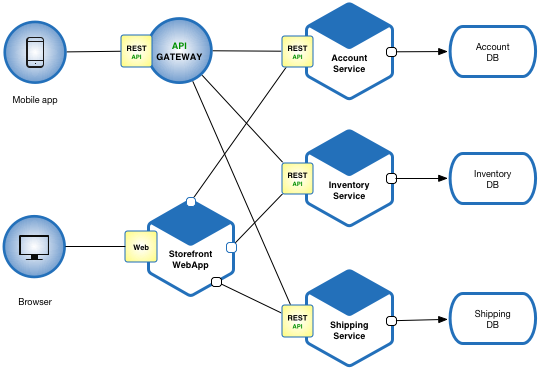
Microservices Architecture
Microservices Architecture is a software design pattern where applications are structured as a collection of small, independent services. Each service in a microservices architecture performs a specific business function and communicates with other services over well-defined APIs.
Key Characteristics of Microservices
- Independent Services: Each service is self-contained, handling a specific function, like user management, order processing, or payment.
- Loose Coupling: Services are loosely connected, meaning they can function independently of each other. This makes the system more resilient and easier to scale.
- Independent Deployment: Each service can be deployed, updated, or scaled without affecting other parts of the system.
- Decentralized Data Management: Each service manages its own data, rather than relying on a central database, allowing for optimized data handling.
Benefits of Microservices
- Scalability: Individual services can scale based on demand, optimizing resources.
- Fault Isolation: Issues in one service do not bring down the entire system.
- Technology Flexibility: Teams can use different technologies for different services.
- Faster Development and Deployment: Teams can work on services independently, speeding up the release cycle.
Example of Microservices in an E-Commerce Application
In an e-commerce application, microservices can be used to divide different functionalities into individual services:
- User Service: Manages user registration, authentication, and profile.
- Product Service: Handles product catalog, including details and inventory.
- Order Service: Manages order placement, tracking, and history.
- Payment Service: Processes payments and handles billing.
- Notification Service: Sends notifications such as order confirmations, alerts, or updates.
Each service can operate independently, allowing the e-commerce application to scale based on specific needs (e.g., the product catalog service may need more resources during peak shopping seasons).
Microservices vs. Monolithic Architecture
| Feature | Monolithic Architecture | Microservices Architecture |
|---|---|---|
| Structure | Single, unified application | Collection of independent services |
| Deployment | All components deployed together | Each service deployed separately |
| Scalability | Limited to scaling the entire application | Scales specific services as needed |
| Fault Tolerance | Failure in one part affects the entire app | Isolated faults, easier recovery |
| Technology Stack | Uniform, single technology | Diverse technologies per service |
Challenges of Microservices
- Complexity: Managing multiple services can add complexity to development and deployment.
- Data Management: Ensuring data consistency across services is challenging, as each service may have its own database.
- Network Overhead: Communication between services over APIs can introduce latency.
- Testing and Debugging: Testing distributed systems is more complex than testing a monolithic application.
When to Use Microservices
Microservices are ideal for:
- Large, complex applications with diverse functionalities.
- Applications requiring high scalability and frequent updates.
- Systems where resilience and fault tolerance are priorities.
Microservices and Event-Driven Architecture
Microservices are often combined with Event-Driven Architecture (EDA) to further decouple services. By using events, services can communicate without directly calling each other, improving flexibility and fault tolerance.